
Satan journeys into the realm of the ancient Egyptian gods -- the falcon god Horus, the cat god Bastet and the jackal god Anubis among them -- to try to bail out the modern Egyptian dictator Hosni Mubarak in the latest episode of "The Devil Made Me Blog It"!
Showing posts with label Israel. Show all posts
Showing posts with label Israel. Show all posts
Wednesday, February 9, 2011


Friday, February 4, 2011
Denial More Than Just River in Egypt

Things sure look tough for embattled Egyptian leader Hosni Mubarak. Satan and Frank Faust ponder his -- and Egypt's -- fate in the latest episode of "The Devil Made Me Blog It"!
Tuesday, June 15, 2010
A Pyrrhic Victory for Free Speech
Seems like some college students are hitting the barricades more than the books, and university administrators have set an admirable but flawed precedent to deal with them.
The University of California at Irvine has recommended a one-year suspension for its Muslim Student Union after members of the group repeatedly disrupted a February speech by Israeli ambassador Michael Oren at the college campus. Among their comments: "Michael Oren, propagating murder is not an expression of free speech." Of all the charges the university launched at the MSU, the one that seemed to stick most was "participation in a disturbance of the peace or unlawful assembly."
In considering the benefits that colleges offer to students, one of the most important is exposure to ideas with which they disagree. The preacher's daughter from the Bible Belt can take a course in evolution ... the Cambridge liberal can study how rent control and Social Security are economically questionable ... and Jewish and Muslim students alike can explore the facts of the Israeli-Palestinian crisis.
The corollary to this is that colleges need to teach students how to disagree. No one should sit mutely through a speech they find objectionable, but neither should they throw tantrums worthy of a two-year-old. Going to college implies that we should act in a collegial manner, after all, and as the town-hall protests over health care showed, too many Americans aren't doing that these days. For the spirit of intellectual inquiry to progress, in college campuses and beyond, we need a respectful medium.
A one-year suspension for the MSU is a positive step toward showing students the difference between right and wrong ways of dissent. Yet it raises some vexing issues. Will colleges across the United States act so vigorously when other student groups act up in ways that administrators might secretly admire? I'm thinking about:
Of course, there is an easier way to teach students how to express dissent, and that is through debate. I wonder if the MSU would have been so prone to act disrespectfully had the university brought in Ambassador Oren not as a solo speaker, but as someone debating the Israeli side of Mideast issues with a pro-Palestinian counterpart. (Harvard, for instance, did this several years ago in an exchange between Noam Chomsky and Allan Dershowitz.) Ultimately, dialogue might be the best deterrent to disrespect.
The University of California at Irvine has recommended a one-year suspension for its Muslim Student Union after members of the group repeatedly disrupted a February speech by Israeli ambassador Michael Oren at the college campus. Among their comments: "Michael Oren, propagating murder is not an expression of free speech." Of all the charges the university launched at the MSU, the one that seemed to stick most was "participation in a disturbance of the peace or unlawful assembly."
In considering the benefits that colleges offer to students, one of the most important is exposure to ideas with which they disagree. The preacher's daughter from the Bible Belt can take a course in evolution ... the Cambridge liberal can study how rent control and Social Security are economically questionable ... and Jewish and Muslim students alike can explore the facts of the Israeli-Palestinian crisis.
The corollary to this is that colleges need to teach students how to disagree. No one should sit mutely through a speech they find objectionable, but neither should they throw tantrums worthy of a two-year-old. Going to college implies that we should act in a collegial manner, after all, and as the town-hall protests over health care showed, too many Americans aren't doing that these days. For the spirit of intellectual inquiry to progress, in college campuses and beyond, we need a respectful medium.
A one-year suspension for the MSU is a positive step toward showing students the difference between right and wrong ways of dissent. Yet it raises some vexing issues. Will colleges across the United States act so vigorously when other student groups act up in ways that administrators might secretly admire? I'm thinking about:
- the Arizona undergrad who threw a pie at Ann Coulter
- the New School students who slammed John McCain on graduation day
- and the free-Tibet activists (I was one of them) who demonstrated against the Chinese government's visit to Harvard back in 1997.
Of course, there is an easier way to teach students how to express dissent, and that is through debate. I wonder if the MSU would have been so prone to act disrespectfully had the university brought in Ambassador Oren not as a solo speaker, but as someone debating the Israeli side of Mideast issues with a pro-Palestinian counterpart. (Harvard, for instance, did this several years ago in an exchange between Noam Chomsky and Allan Dershowitz.) Ultimately, dialogue might be the best deterrent to disrespect.
Thursday, June 3, 2010
Paintball Wizards on the Gaza Strip

Questions abound in the wake of Israel's response to the Gaza aid flotilla. Is Turkey right to show righteous indignation given its own murky human rights record? Does Israel's use of paintball guns show that it acted moderately before using the real thing? Satan and Frank Faust discuss these issues and more in the latest episode of "The Devil Made Me Blog It"!
Friday, May 21, 2010
Forgetting the Fundamentals
The relationship between the Secular Left and the Religious Right often resembles a battlefield. And the Left needs to know when to call a cease-fire and recognize opportunities for alliance-building, not ideological warfare.
This came to mind on an issue that is bitterly contested between American liberals and conservatives: The Israel-Palestine conflict. The Left has shown a tendency to demonize its opponents without realizing that some of those foes might actually share liberal goals.
Last week, in the New York Review of Books, Peter Beinart bemoaned that young liberal American Jews have lost their parents' identification with Israel and Zionism. Yet this became an unfair jeremiad against young American Jews whose identification with Israel and Zionism is strong: the Orthodox, who tend to be more right-wing.
Beinart's description of liberal young'uns shows his bias. "Because they have inherited their parents’ liberalism, they cannot embrace their uncritical Zionism," he writes. "Because their liberalism is real, they can see that the liberalism of the American Jewish establishment is fake." The assumption is that only young liberals can be so perceptive, so discerning.
Of course, Beinart ignores the fact that Israeli conservatives have worked quite well on occasion in forging peace deals with their Mideast neighbors. It was, after all, the former Irgun terrorist/prime minister Menachem Begin who signed the historic accord with Egypt ... and the former Lebanon warmonger/prime minister Ariel Sharon who got the settlers out of Gaza.
Yes, current prospects on the right, whether in Israel or the US, do not look terribly appetizing, especially with unsavory characters like Avigdor Lieberman holding power in Israel. If young liberal American Jews turn away from Israel and Zionism as a result, and the leadership vacuum is filled with more bellicose voices, then what could result is Beinart's nightmare scenario of "an American Zionist movement that does not even feign concern for Palestinian dignity and a broader American Jewish population that does not even feign concern for Israel."
If the liberal movements in both the US and Israel want to reverse this trend, they should stop demonizing the right-wingers and seek common ground with them toward a peaceful future. If Begin and Sharon found paths to peace, there is no reason why today's right-wingers can't do the same. Here's a thought: Maybe whoever buys the wine for Orthodox services in Israel and the US could get it from Cremisan Cellars, a winery located on the border between Jerusalem and the West Bank. Such small yet significant steps could help move both Left and Right in the direction of a peaceful future.
This came to mind on an issue that is bitterly contested between American liberals and conservatives: The Israel-Palestine conflict. The Left has shown a tendency to demonize its opponents without realizing that some of those foes might actually share liberal goals.
Last week, in the New York Review of Books, Peter Beinart bemoaned that young liberal American Jews have lost their parents' identification with Israel and Zionism. Yet this became an unfair jeremiad against young American Jews whose identification with Israel and Zionism is strong: the Orthodox, who tend to be more right-wing.
Beinart's description of liberal young'uns shows his bias. "Because they have inherited their parents’ liberalism, they cannot embrace their uncritical Zionism," he writes. "Because their liberalism is real, they can see that the liberalism of the American Jewish establishment is fake." The assumption is that only young liberals can be so perceptive, so discerning.
Of course, Beinart ignores the fact that Israeli conservatives have worked quite well on occasion in forging peace deals with their Mideast neighbors. It was, after all, the former Irgun terrorist/prime minister Menachem Begin who signed the historic accord with Egypt ... and the former Lebanon warmonger/prime minister Ariel Sharon who got the settlers out of Gaza.
Yes, current prospects on the right, whether in Israel or the US, do not look terribly appetizing, especially with unsavory characters like Avigdor Lieberman holding power in Israel. If young liberal American Jews turn away from Israel and Zionism as a result, and the leadership vacuum is filled with more bellicose voices, then what could result is Beinart's nightmare scenario of "an American Zionist movement that does not even feign concern for Palestinian dignity and a broader American Jewish population that does not even feign concern for Israel."
If the liberal movements in both the US and Israel want to reverse this trend, they should stop demonizing the right-wingers and seek common ground with them toward a peaceful future. If Begin and Sharon found paths to peace, there is no reason why today's right-wingers can't do the same. Here's a thought: Maybe whoever buys the wine for Orthodox services in Israel and the US could get it from Cremisan Cellars, a winery located on the border between Jerusalem and the West Bank. Such small yet significant steps could help move both Left and Right in the direction of a peaceful future.
Friday, May 7, 2010
Sharansky: Power to the Peoplehood
Natan Sharansky, the former Russian refusenik and Israeli Cabinet member and the new head of the Jewish Agency, has a mission: Peoplehood. He wants Jews to think more about themselves as a worldwide people and less about the religious and Israel-connected aspects of Judaism. Reports the Forward:
This could spark the biggest redefinition of Jewish identity since Moses came down from Mount Sinai, and it seems like a positive step. The Diaspora scattered us across the globe, and its effects keep us disunited today. Most of my coreligionists in the greater Boston area of Massachusetts are fellow Ashkenazim and not Sephardim or Mizrahis. When I think Jewish cuisine, I imagine bagels, lox and latkes instead of a Mediterranean meze. There are differences in how the different strands of my people celebrate holidays, but I couldn’t tell you what those differences are.
That said, Jewish organizations in Greater Boston have taken laudable measures to welcome Jews from other countries into the community. Several years ago, an Ethiopian Jew working in the Boston area spoke about her heritage at the Vilna Shul. The Boston Jewish community has also come together to mark the anniversary of the tragic bombing of a Jewish center in Buenos Aires, Argentina. These steps are heartening, for belonging to a people implies a sense of collective care, and we can’t care about each other if we don’t know about each other: who we are, where we live, how we worship. (Argentina was No. 7 on the list of countries with the largest Jewish populations in a 2006 study.) More steps in this direction would certainly be welcome.
What is troubling, though, about Sharansky’s idea of peoplehood is that it “is not predicated on having any kind of religious or spiritual identity,” the Forward reports. One possibility for this is rooted in Sharansky’s own experiences in Israel. In “Israel at Sixty: An Oral History of a Nation Reborn,” he said:
Yet it seems that if Sharansky encourages Jews worldwide to think of ourselves as one people across many cultures, he can similarly encourage us to think of ourselves as one people across many religious wavelengths. No matter where we are today, our ancestors were there in some form when Moses recited the Ten Commandments. (Whether they heeded them or not is another story.)
Overall, though, Sharansky’s idea deserves praise. The Diaspora may have scattered us, but appreciating our cultural diversity can bring us back together.
(Sharansky) and a tight group of ideological allies … believe that the Jewish Agency must now become a global promoter of Jewish identity, particularly among the young. Peoplehood, according to its proponents, is defined as a sense of connectivity between Jews who share a common history and fate.
This could spark the biggest redefinition of Jewish identity since Moses came down from Mount Sinai, and it seems like a positive step. The Diaspora scattered us across the globe, and its effects keep us disunited today. Most of my coreligionists in the greater Boston area of Massachusetts are fellow Ashkenazim and not Sephardim or Mizrahis. When I think Jewish cuisine, I imagine bagels, lox and latkes instead of a Mediterranean meze. There are differences in how the different strands of my people celebrate holidays, but I couldn’t tell you what those differences are.
That said, Jewish organizations in Greater Boston have taken laudable measures to welcome Jews from other countries into the community. Several years ago, an Ethiopian Jew working in the Boston area spoke about her heritage at the Vilna Shul. The Boston Jewish community has also come together to mark the anniversary of the tragic bombing of a Jewish center in Buenos Aires, Argentina. These steps are heartening, for belonging to a people implies a sense of collective care, and we can’t care about each other if we don’t know about each other: who we are, where we live, how we worship. (Argentina was No. 7 on the list of countries with the largest Jewish populations in a 2006 study.) More steps in this direction would certainly be welcome.
What is troubling, though, about Sharansky’s idea of peoplehood is that it “is not predicated on having any kind of religious or spiritual identity,” the Forward reports. One possibility for this is rooted in Sharansky’s own experiences in Israel. In “Israel at Sixty: An Oral History of a Nation Reborn,” he said:
(There) are so many groups that belong to different worlds that religion becomes not something that unites us with the generations before and with our future, but a political tool that divides people, a lack of tolerance among different groups…
Yet it seems that if Sharansky encourages Jews worldwide to think of ourselves as one people across many cultures, he can similarly encourage us to think of ourselves as one people across many religious wavelengths. No matter where we are today, our ancestors were there in some form when Moses recited the Ten Commandments. (Whether they heeded them or not is another story.)
Overall, though, Sharansky’s idea deserves praise. The Diaspora may have scattered us, but appreciating our cultural diversity can bring us back together.
Friday, April 2, 2010
J Street "Wrong Way" for Israel, US?

Wednesday, June 3, 2009
Unsettling times for Israel-Fatah peace prospects
Let's say you're the State of Israel. The Palestinian governments in the West Bank and Gaza Strip are divided between Fatah and Hamas. You have an opportunity to bridge relations between one of them -- Fatah. So what do you do? Antagonize Fatah, of course!
That's what's happening thanks to Prime Minister Benjamin "Bibi" Netanyahu, whose government is eager to build new settlement housing in the West Bank. The West Bank, of course, is where the Fatah government of President Mahmoud Abbas just happens to reside.
"'You can't freeze life' in the settlements, an official quoted Netanyahu as saying, defending his view that existing settlements must expand to accommodate growing families," Reuters reported on Wednesday.
Brilliant, Bibi, just brilliant. Not only does this put a dent in any friendly relations you were hoping to cultivate with Fatah, it also risks the goodwill between Israel and the Obama Administration.
Of course, there are reasons for Netanyahu encouraging the settlers. Israel, after all, is one of the world's most densely populated countries, and its people sure can't expand into the Negev Desert, as the government's motto there seems to have changed from "make the desert bloom" to "make the desert a toxic waste dump." Israeli expansion into the West Bank would potentially increase the population of the country while keeping the religious right happy. And as far as jeopardizing relations with the Obama Administration, the New York Times noted, our 44th president may be realizing his predecessors weren't able to do much about stopping settlements.
Israel should curb its desire to create and sustain illegal settlements, and foster goodwill between itself and Fatah. Unfortunately, it looks like Netanyahu will bulldoze not only more land in the West Bank, but also the prospect of peace between Israel and Fatah.
That's what's happening thanks to Prime Minister Benjamin "Bibi" Netanyahu, whose government is eager to build new settlement housing in the West Bank. The West Bank, of course, is where the Fatah government of President Mahmoud Abbas just happens to reside.
"'You can't freeze life' in the settlements, an official quoted Netanyahu as saying, defending his view that existing settlements must expand to accommodate growing families," Reuters reported on Wednesday.
Brilliant, Bibi, just brilliant. Not only does this put a dent in any friendly relations you were hoping to cultivate with Fatah, it also risks the goodwill between Israel and the Obama Administration.
Of course, there are reasons for Netanyahu encouraging the settlers. Israel, after all, is one of the world's most densely populated countries, and its people sure can't expand into the Negev Desert, as the government's motto there seems to have changed from "make the desert bloom" to "make the desert a toxic waste dump." Israeli expansion into the West Bank would potentially increase the population of the country while keeping the religious right happy. And as far as jeopardizing relations with the Obama Administration, the New York Times noted, our 44th president may be realizing his predecessors weren't able to do much about stopping settlements.
Many in the Muslim world are waiting to see what Mr. Obama will do if, as expected, Israel ignores his request on the settlements. When asked about this ... Mr. Obama indicated that he was not yet ready to stipulate an "or else,” despite the fact that several American presidents before him have demanded settlement freezes in Israel and been ignored.But what about keeping Israel's neighbors happy? The peace treaties of 1979 with Egypt and of 1994 with Jordan brought good results for Israel and neighboring nations (less hostilities, more American aid). While the hope created by the Oslo Accords of 1993 transformed into disillusionment and despair after the Al Aqsa Intifada of 2000, relations between Fatah and Israel seemed to improve recently, given that the governments share an enemy in Hamas.
Israel should curb its desire to create and sustain illegal settlements, and foster goodwill between itself and Fatah. Unfortunately, it looks like Netanyahu will bulldoze not only more land in the West Bank, but also the prospect of peace between Israel and Fatah.
Friday, April 24, 2009
Walking out on Ahmadinejad
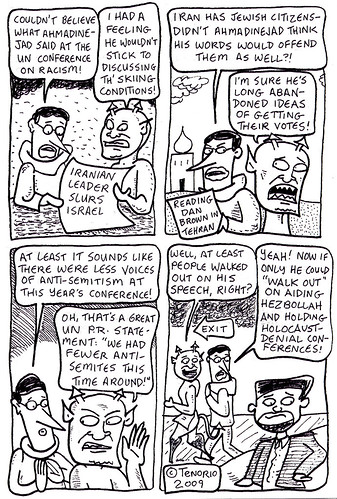
Maybe Iran president Mahmoud Ahmadinejad should have stuck to discussing the skiing conditions at the UN conference on racism in Geneva. Instead, he insulted Israel in a speech ... which prompted other attendees to walk out. Mephistopheles and Frank Faust discuss the speech -- and the reaction it caused -- in the latest episode of "The Devil Made Me Blog It"!
Wednesday, April 15, 2009
A tale of two hostage crises
It took five days for the US Navy to rescue Captain Richard Phillips from Somali pirates who had captured his ship ... but Israeli Defense Forces soldier Gilad Shalit still languishes in Hamas captivity over 1,000 days after militants took him prisoner. Why did the Navy mission succeed, and Israeli efforts (so far) fail?
A lot of it has to do with geography. For all their technological prowess -- the New York Times described Phillips' captors as "armed with pistols and AK-47s" -- the pirates were undone by the fact they were operating on the open sea. "By the weekend," the Times reported, "the pirates had begun to run out of food, water and fuel. That apparently provided the opening officials were hoping for."
Shalit, by contrast, is at the mercy of not a group of four pirates, but a Hamas government entrenched in the Gaza Strip, which the BBC called "one of the most densely populated tracts of land in the world." Locating him here seems difficult, so perhaps it's inevitable for Israel to try to rescue him through diplomatic means, although progress in talks seems slow. YNet News reported that a Hamas "official cited the election of a new Israeli government as the reason no breakthrough was expected in the coming months."
So what can we do? The Times involved its readers in the crisis off Somalia by soliciting solutions. For anyone following the Shalit saga, there are a number of ways to call for action. There is an online petition that urges Secretary of State Clinton to make the US' humanitarian aid pledge to Gaza -- the petition says it's $300 million, the Times (UK, not NY) says it's $900 million -- contingent upon his release, which my friend Martin mentioned to me in an email. Shalit holds dual French and Israeli citizenship; perhaps pressure on Sarko -- and on Egypt and the Vatican, which have gotten involved in negotiations, as well as on the International Committee of the Red Cross, which Hamas has prevented from seeing Shalit -- could result in positive results. Let's hope that someday soon, Shalit will have the same freedom from captivity that Captain Phillips now enjoys.
A lot of it has to do with geography. For all their technological prowess -- the New York Times described Phillips' captors as "armed with pistols and AK-47s" -- the pirates were undone by the fact they were operating on the open sea. "By the weekend," the Times reported, "the pirates had begun to run out of food, water and fuel. That apparently provided the opening officials were hoping for."
Shalit, by contrast, is at the mercy of not a group of four pirates, but a Hamas government entrenched in the Gaza Strip, which the BBC called "one of the most densely populated tracts of land in the world." Locating him here seems difficult, so perhaps it's inevitable for Israel to try to rescue him through diplomatic means, although progress in talks seems slow. YNet News reported that a Hamas "official cited the election of a new Israeli government as the reason no breakthrough was expected in the coming months."
So what can we do? The Times involved its readers in the crisis off Somalia by soliciting solutions. For anyone following the Shalit saga, there are a number of ways to call for action. There is an online petition that urges Secretary of State Clinton to make the US' humanitarian aid pledge to Gaza -- the petition says it's $300 million, the Times (UK, not NY) says it's $900 million -- contingent upon his release, which my friend Martin mentioned to me in an email. Shalit holds dual French and Israeli citizenship; perhaps pressure on Sarko -- and on Egypt and the Vatican, which have gotten involved in negotiations, as well as on the International Committee of the Red Cross, which Hamas has prevented from seeing Shalit -- could result in positive results. Let's hope that someday soon, Shalit will have the same freedom from captivity that Captain Phillips now enjoys.
Friday, March 20, 2009
Supporters: Would Israel Have "Lost Them Anyway"?
"Could've tried just a little bit harder
Kissed you just a little bit sweeter
Held on just a little bit longer
Dug down just a little bit deeper" ~Toby Keith
Even if he had taken all these measures, the imaginary lover in TK's country anthem notes to his ex, he would have "Lost You Anyway." The State of Israel, however, is hoping this won't be the case with its support abroad.
"Global opinion surveys are being closely examined and the Foreign Ministry has been granted an extra $2 million to improve Israel’s image through cultural and information diplomacy," the New York Times reported.
Why the push to "improve Israel's image"? Well, the country has recently concluded a war with Hamas in the Gaza Strip that prompted accusations of atrocities committed by the Israeli Defense Forces. And the unsavory Avigdor Lieberman, head of the Yisrael Beytenu party, has risen to the forefront with calls for deportation of Israeli Arabs who won't take a loyalty oath. With friends like these...well, let the Times finish the sentence.
It also sounds like the Israeli reaction to criticism of its actions contains more seriousness than spin. That's important, too, because it shows a more realistic response than what it did when it invaded Lebanon in 1982. Quoth Thomas Friedman in "From Beirut to Jerusalem":
Kissed you just a little bit sweeter
Held on just a little bit longer
Dug down just a little bit deeper" ~Toby Keith
Even if he had taken all these measures, the imaginary lover in TK's country anthem notes to his ex, he would have "Lost You Anyway." The State of Israel, however, is hoping this won't be the case with its support abroad.
"Global opinion surveys are being closely examined and the Foreign Ministry has been granted an extra $2 million to improve Israel’s image through cultural and information diplomacy," the New York Times reported.
Why the push to "improve Israel's image"? Well, the country has recently concluded a war with Hamas in the Gaza Strip that prompted accusations of atrocities committed by the Israeli Defense Forces. And the unsavory Avigdor Lieberman, head of the Yisrael Beytenu party, has risen to the forefront with calls for deportation of Israeli Arabs who won't take a loyalty oath. With friends like these...well, let the Times finish the sentence.
The gap between Israelis and many liberal American Jews could be seen Tuesday inIn the Boston area, where this correspondent is based, organizations such as Combined Jewish Philanthropies and the Jewish Community Relations Council have led efforts to reach out to American Jews, sponsoring lunchtime lectures by Israeli authorities such as Hebrew University professor Reuven Hazan and activist Avi Melamed to explain aspects of Israeli politics to Jews in the diaspora. And that's important, given that other voices in the Israeli-Palestinian conflict have been far from silent -- like those who hold "Israeli Apartheid Week" events.
a blog by Bradley Burston, who writes on the Web site of the left-leaning
newspaper Haaretz. He said that while visiting Los Angeles he faced many
questions that amounted to “What is wrong with these people, your friends, the
Israelis?”
He quoted an article by Anne Roiphe, an American Jewish liberal,
which said that witnessing the popularity of Mr. Lieberman in Israel made her
feel “as if my spouse had cheated on me with Mussolini.”
It also sounds like the Israeli reaction to criticism of its actions contains more seriousness than spin. That's important, too, because it shows a more realistic response than what it did when it invaded Lebanon in 1982. Quoth Thomas Friedman in "From Beirut to Jerusalem":
The Hadassah women and the big donors to the United Jewish appeal wereWhen Israel invaded Lebanon, we got the massacres of Sabra and Shatila. Let's hope that in the wake of its current crises with its neighbors and within, Israel acts humanely -- and conveys that message to people abroad.
bussed up to East Beirut and taken by the Israeli army on special tours of the
front, where they got to pose in flak jackets atop mud-splattered tanks and peer
through binoculars at real live artillery blasting real live "terrorists." The
really big donors -- $100,000 a year and above -- got special intelligence
briefings with topographical maps. (132)
Wednesday, February 11, 2009
Israel Elections: Nobody Wins, We All Lose
Israeli voters leaned toward one of two candidates in national elections this week: Binyamin "Bibi" Netanyahu, who screwed up the peace process over a decade ago, and Tzipi Livni, who screwed up the Gaza Strip situation a few weeks ago. Which will they choose?
Here is an assessment of the directions Israel could go in:
Here is an assessment of the directions Israel could go in:
- Older and wiser, or just older? Netanyahu eventually became prime minister after the assassination of Nobel Peace Prize winner Yitzhak Rabin in 1995. Bibi's hawkishness -- along with, of course, the flaws of his Palestinian counterpart, Yasser Arafat -- helped clip the wings of the dove of peace that seemed so promising with the 1993 signing of the Oslo Accords. Has Bibi learned from his mistakes as PM from 1996-99? Or will he turn even more macho in the wake of threats from Hamas, Hezbollah, Syria, and Iran?
- Present imperfect. Livni led a war against Hamas in Gaza that resulted in international outcry against Israel -- although we must admit that Israel cannot move a tank from its base without drawing protests -- and, more seriously, failed to silence the rockets from Gaza or curtail their increasing distance.
- Blinded by the right(-wing). Meet Avigdor Lieberman, would-be kingmaker (or prime minister-maker), whose Yisrael Beytenu party thinks it's a good idea to add fuel to an already-tense situation by displacing Israeli Arabs. "The responsibility for primarily Arab areas such as Umm Al-Fahm and the 'triangle' will be transferred to the Palestinian Authority," the party website proclaims in its platform. "In parallel, Israel will officially annex Jewish areas in Judea and Samaria. Israel is our home; Palestine is theirs." Yisrael Beytenu is one more right-wing threat to a country that has enough of them.
Thursday, January 15, 2009
Israel hits UN building in Gaza
Israel struck a UN building in Gaza City on Thursday. The government of Prime Minister Ehud Olmert explained that its forces near the building drew fire and acted in response. Unfortunately for Israel, this has prompted criticism from UN Secretary-General Ban Ki-moon.
The relevant questions here are: What did the building -- the headquarters of the UN Relief and Works Agency -- look like? Who was inside it, or close to it, when the military attacked? Were they UN personnel? Refugees? Hamas militants?
From what a UN official told the New York Times, the area attacked was a complex consisting of at least two buildings, as well as five fully-laden fuel-carrying vehicles. Already there are conflicting stories. The official denied any militant activity, while Israel argued that it happened.
Those following this conflict will get multiple perspectives -- Israeli, Hamas, and UN. We need a comprehensive picture of the situation at this building before criticizing Israel for its action.
As for the UN's response, Secretary Ban has a choice. He could keep his agency in Gaza, or he could pull it out. The UN did the latter after terrorists attacked several of its facilities in Iraq in 2003. We will see whether the UN acts differently here.
The relevant questions here are: What did the building -- the headquarters of the UN Relief and Works Agency -- look like? Who was inside it, or close to it, when the military attacked? Were they UN personnel? Refugees? Hamas militants?
From what a UN official told the New York Times, the area attacked was a complex consisting of at least two buildings, as well as five fully-laden fuel-carrying vehicles. Already there are conflicting stories. The official denied any militant activity, while Israel argued that it happened.
Those following this conflict will get multiple perspectives -- Israeli, Hamas, and UN. We need a comprehensive picture of the situation at this building before criticizing Israel for its action.
As for the UN's response, Secretary Ban has a choice. He could keep his agency in Gaza, or he could pull it out. The UN did the latter after terrorists attacked several of its facilities in Iraq in 2003. We will see whether the UN acts differently here.
Thursday, January 8, 2009
Images of Iraq and Israel
On the last day of 2008, my friend and I visited the Museum of Fine Arts in Boston to see images of a time and place far removed from ours. We saw works of art from the Assyrian Empire, whose rulers governed much of the Middle East 600 years before the birth of Christ.
As my friend pointed out, much of the art frankly depicted the Assyrians' wars: soldiers beheading enemies, hauling their bodies onto poles, and taking their families into captivity. Even the physical appearance of the enemy was not spared: one hapless monarch was repeatedly portrayed with a receding hairline.
With the US now approaching Year Six of the Iraq War, and Israel launching attacks on Gaza for a little less than two weeks, I'm thinking about the way the Assyrians portrayed war then, and the way that the media portrays it today. The Assyrians boasted about the atrocities they committed, creating intricate wall-size panels out of stone. Over two thousand years later, however, the American and Israeli governments and media organizations are more cautious. The Bush Administration, for instance, has prevented news organizations from photographing the coffins of US soldiers killed in combat, while the Israeli government has restricted media coverage of the Gaza Strip since the conflict began.
Where the Assyrians were frank, the nations of today do not want the general public to see what war brings. Perhaps the Bush Administration remembers the outcry after photos of prisoner abuse at Abu Ghraib became public. Then again, it is possible to manipulate war photos to create false images, which happened to the Israeli government during its war against Hezbollah in 2006. Both reasons could explain the reluctance of the US and Israel to allow the media to do what the Assyrian artists once did: Show what happened. And perhaps this reflects a change in the way people and governments across the globe see war -- not as an image to display triumphantly, but as something to conceal. I don't think that's progress. What would be progress is if we saw war as something to confront and discuss honestly.
As my friend pointed out, much of the art frankly depicted the Assyrians' wars: soldiers beheading enemies, hauling their bodies onto poles, and taking their families into captivity. Even the physical appearance of the enemy was not spared: one hapless monarch was repeatedly portrayed with a receding hairline.
With the US now approaching Year Six of the Iraq War, and Israel launching attacks on Gaza for a little less than two weeks, I'm thinking about the way the Assyrians portrayed war then, and the way that the media portrays it today. The Assyrians boasted about the atrocities they committed, creating intricate wall-size panels out of stone. Over two thousand years later, however, the American and Israeli governments and media organizations are more cautious. The Bush Administration, for instance, has prevented news organizations from photographing the coffins of US soldiers killed in combat, while the Israeli government has restricted media coverage of the Gaza Strip since the conflict began.
Where the Assyrians were frank, the nations of today do not want the general public to see what war brings. Perhaps the Bush Administration remembers the outcry after photos of prisoner abuse at Abu Ghraib became public. Then again, it is possible to manipulate war photos to create false images, which happened to the Israeli government during its war against Hezbollah in 2006. Both reasons could explain the reluctance of the US and Israel to allow the media to do what the Assyrian artists once did: Show what happened. And perhaps this reflects a change in the way people and governments across the globe see war -- not as an image to display triumphantly, but as something to conceal. I don't think that's progress. What would be progress is if we saw war as something to confront and discuss honestly.
Wednesday, January 7, 2009
Hamas rockets, Israeli response

Israel Cartoon
Originally uploaded by rbtenorio
The Israeli attacks on Gaza have lasted over a week. Hamas, meanwhile, continues the rocket attacks on Israel that prompted the Israeli response after a cease-fire ended. Satan and his liberal friend discuss the situation in the latest episode of "The Devil Made Me Blog It."
Subscribe to:
Comments (Atom)

 Posts
Posts